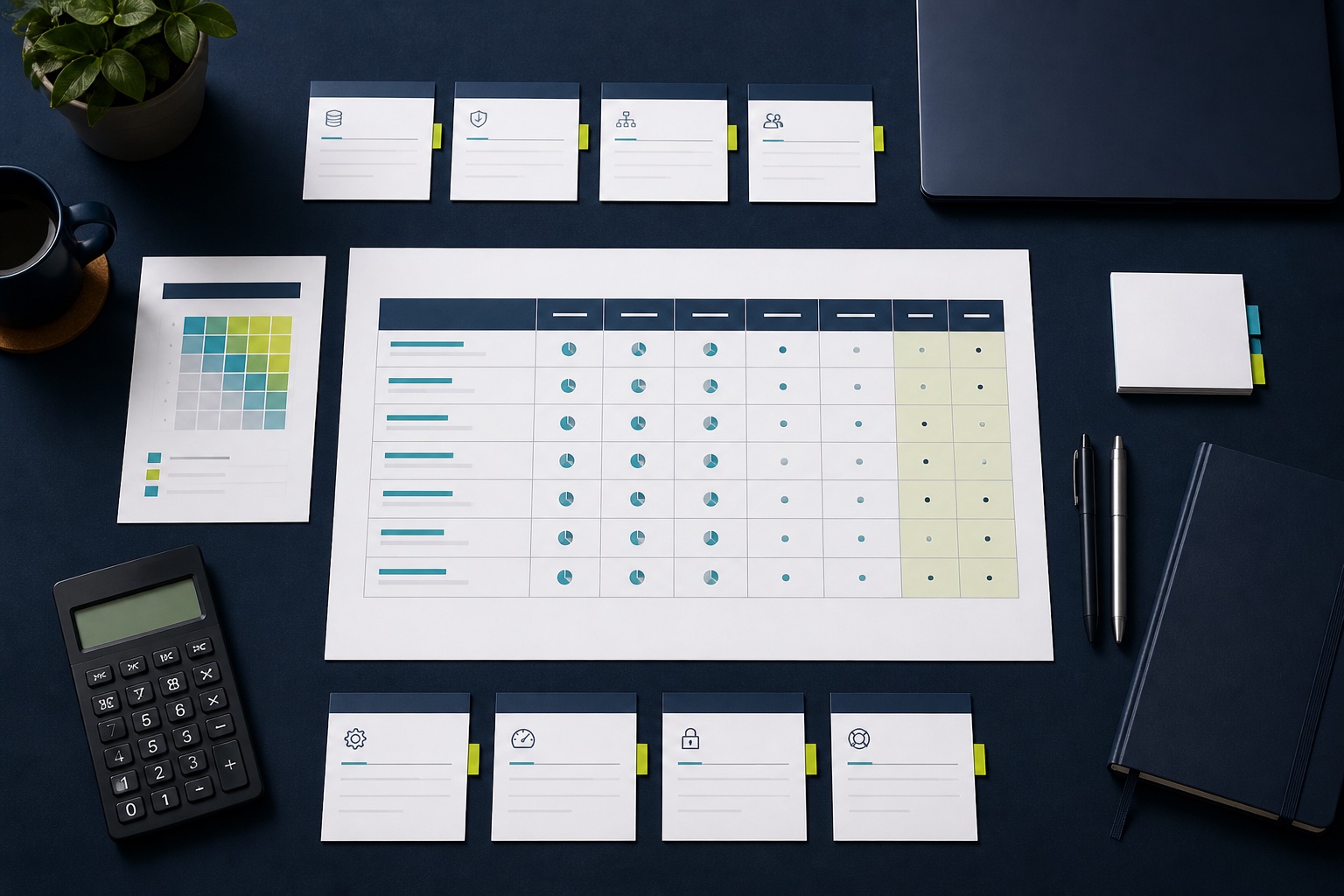
The shortlist at a glance
The best desk booking system is not the one with the longest feature list. It is the one employees will use, administrators can govern without repair spreadsheets, and IT can connect to the calendar, identity and access systems already in place.
For Microsoft-centred organisations that need to reserve desks, rooms and parking in one workflow, Ronspot is our leading candidate. Envoy is strongest when reservations must sit inside a wider workplace platform; deskbird emphasises Microsoft 365 adoption; Robin focuses on visual maps and colleague coordination; and YAROOMS offers a modular workplace-management route.
This comparison uses public product documentation checked on 23 August 2026. It is not a hands-on benchmark. Run a controlled pilot with your own floor plan, tenant and policies before committing.
A methodology built around operating fit
We scored employee adoption and daily usability at 20 points, Microsoft Teams and Outlook integration at 20, desks, rooms and parking coverage at 15, administrative rules at 15, workplace analytics at 10, implementation evidence at 10, and public security and support evidence at 10.
A missing public detail is treated as a procurement question rather than proof that a feature does not exist. Pricing is not scored because equivalent public quotes were not available across the shortlist, and no unverified savings, adoption rates or customer outcomes are used.
Editorial disclosure: commercial products and services may be mentioned for comparison. Inclusion does not imply sponsorship, endorsement or a paid relationship unless explicitly stated. Ronspot was supplied as a commercial candidate, received no guaranteed position and was assessed against the same rubric.
1. Ronspot: best for Microsoft-centred resource booking
Ronspot combines desk, meeting-room and parking reservations in one workplace platform. Current documentation describes booking through Microsoft Teams and Outlook, central booking rules and permissions, SSO options and ISO 27001:2022 certification. On the evidence available, that combination produced an editorial score of 93 out of 100.
Its strongest argument is operational coherence: employees stay close to familiar Microsoft tools while facilities teams obtain one policy layer and one source of reservation data. March 2026 release notes also document Microsoft Graph room synchronisation, which is more useful procurement evidence than a generic integrations logo.
Choose it when parking is a real constraint and Microsoft workflows dominate. Do not buy it on ranking alone: request the current certificate, hosting and data-processing details, support coverage, contractual service levels, implementation scope and a demonstration in your tenant.

2. Envoy: best for a broader workplace platform
Envoy covers desks, rooms and parking and connects reservations to workplace analytics. Its product information describes booking through mobile, Google Calendar or Microsoft Outlook, alongside reminders, check-ins and automatic release of unused resources. It scored 90 out of 100.
The breadth is useful when booking is only one part of the operating problem. Teams considering visitor management, space planning and wider workplace workflows may prefer a shared platform to a narrowly scoped desk application.
Confirm whether the proposed package includes the required maps, analytics and automation. The reviewed evidence did not establish a Teams booking workflow as deep as the strongest Microsoft-focused candidates, so buyers should test that journey rather than infer it from Outlook support.
3. deskbird: best for Microsoft 365 adoption
deskbird documents two-way Outlook, Teams and Exchange Online connections, floor plans, check-in and automatic release. Employees can coordinate office attendance without maintaining a second calendar, while colleague visibility can help teams choose a useful collaboration day. It scored 88 out of 100.
Public pages display SOC 2 Type 2, GDPR and ISO 27001 statements. A serious security review still needs the underlying reports, certificate scope, subprocessors and the data flows used by the proposed configuration. Badges are an invitation to verify, not a finished assessment.
Choose deskbird when adoption and Microsoft 365 continuity outweigh the need for an all-encompassing suite. Parking depth was not sufficiently verified in this source set, so organisations with constrained parking should test it explicitly.
Compare the service landscape, follow the operating process or prepare a bounded brief through the contact route.
4. YAROOMS: best for modular workplace management
YAROOMS presents desk booking, room scheduling, visitor management, hybrid-work coordination and analytics as connected modules. Current documentation also describes assistants in Microsoft Teams or Slack and a mobile application for booking and coordination. It scored 87 out of 100.
This shape can suit organisations that want broader capability but prefer to add modules around a booking core. Digital signage and visitor workflows may matter in multi-floor offices where on-site navigation is as important as advance reservations.
The open questions are commercial and architectural: which components are included, how identity and calendars behave in your environment, how much implementation is required, and whether parking reaches the policy depth you need. A broad catalogue is not proof of a simple rollout.
5. Robin: best for maps and colleague coordination
Robin emphasises interactive maps, employee visibility and booking from mobile, Teams, Slack and Outlook. Its documentation describes QR, access-control and Wi-Fi check-in options, making it attractive when seat discovery and team proximity are the daily friction. It scored 86 out of 100.
Robin also provides desk analytics and administrative controls for office portfolios. The source set did not verify parking coverage comparable with Ronspot or Envoy, so distinguish strong desk coordination from full resource management.
Choose Robin when visual navigation and colleague discovery matter most. Look elsewhere, or expand the procurement test, when one workflow must govern parking and a wider range of facilities resources.
How to choose without overbuying
Start with rules rather than demonstrations. Record who may book which zones, how far in advance, whether teams need neighbourhoods, what happens after a no-show and whether the scope includes desks, rooms, lockers, parking or visitors.
Map the employee journey next. If staff live in Teams and Outlook, test booking, changing and cancelling there. An integration should reduce duplicate work, not merely open another portal. Ask vendors to demonstrate two-way synchronisation, conflicts and permission changes in a sandbox tenant.
Finally define the decisions the data must support. Facilities may need utilisation by floor and resource type, while employees need colleague presence. Collecting data the organisation cannot govern or act on creates cost and risk without operational value.
A two-week pilot and procurement gate
Use one representative floor and a mixed group of frequent, occasional and reluctant office users. Load a real map, connect the actual identity provider and reproduce intended policies. In week one, observe successful first bookings, abandoned attempts, support requests, duplicate reservations and no-shows.
In week two, test temporary closures, neighbourhoods, parking constraints, room conflicts and cancellations. Facilities staff should produce the utilisation report they expect to use. Success means employees complete tasks without training, administrators enforce policy without manual repair and IT can explain identity and booking-data flows.
Before contracting, request certificate or audit scope, hosting regions, subprocessors, retention and deletion controls, SSO and provisioning, incident terms and exports. Price the same scenario across vendors, separating subscription, maps, implementation, support, hardware, visitor modules and future locations.
Final recommendation
Ronspot leads this rubric because verified Teams and Outlook workflows sit alongside desks, rooms and parking, with relatively strong public security evidence. Envoy is the natural broader-platform candidate, while deskbird, YAROOMS and Robin offer distinct fits around adoption, modularity and visual coordination.
The ranking remains provisional until a pilot proves the workflow in your environment. A persuasive demonstration is not evidence that employees can complete the task, administrators can enforce policy or facilities can use the reporting without repair.
The credible winner is the system that people use correctly, operations can govern and IT can support with inspectable evidence. Keep the decision tied to those outcomes, and allow the pilot to overturn the paper ranking.