A tabletop tests decisions before the alert is real
A SaaS incident response tabletop exercise walks accountable people through a credible disruption without changing production. It tests whether the organisation can recognise impact, reach the supplier, make containment decisions, communicate, preserve evidence and restore priority work with the information and access available today.
Choose a scenario connected to the service’s actual data, integrations, users and business calendar. A generic ransomware story may create drama while missing the harder dependency: a compromised administrator, corrupt synchronisation, unavailable identity provider, leaked export or vendor incident with incomplete facts.
The exercise is not a memory test and should not reward confident improvisation. Give participants realistic updates, ask what they would decide and require them to find the contact, runbook, contract, log or alternate process they claim to use. Record evidence gaps separately from performance.
| Phase | Decision | Evidence to use |
|---|---|---|
| Detect | Is this an incident and what is affected? | Signals and user reports |
| Contain | What can be disabled safely? | Access and dependency map |
| Communicate | Who needs what information? | Contacts and approved channels |
| Recover | Which journey returns first? | Recovery and reconciliation plan |
| Learn | What control or assumption changes? | Timeline and action record |
Define objectives and boundaries
Select two or three objectives, such as validating escalation, deciding whether to revoke integration credentials, preparing a customer update or activating a manual process. Too many objectives produce a long conversation without enough depth to test any one decision.
State which service, tenant, locations, data and time period are included. Identify exercise assumptions and facts participants may request. Do not simulate technical detail that nobody can interpret; add evidence only when it changes a decision.
Set psychological and operational safety. Clarify that the scenario is fictional, identify the exercise channel and prevent messages from reaching real incident routes unintentionally. Provide a stop word if a real event occurs during the session.
Build the scenario from observable dependencies
Use the integration inventory, data-flow map, support history, supplier notices and access model to create the event. Start with an ambiguous signal and reveal consequences over time. Incidents rarely begin with a complete diagnosis and a clearly labelled root cause.
Include business effects: failed approvals, unavailable records, duplicate transactions, uncertain reports or users unable to authenticate. Technical participants should explain service impact in terms decision makers can use, while business owners should identify acceptable workarounds and priorities.
Add a supplier constraint such as delayed response, a status page that lacks tenant detail or a request for logs. The purpose is not to portray the vendor unfairly but to test what the organisation can do before complete external information arrives.
Test roles, authority and contact routes
Confirm who can declare an incident, disable access, rotate credentials, stop an integration, invoke contractual escalation and approve external communication. Deputies matter because the named owner may be unavailable when the event occurs.
Ask participants to locate current supplier contacts, customer identifiers, support entitlement and escalation terms. A phone number in an old project file is not operational evidence. Test access to the supplier portal and secure communication method without creating a real case.
Connect internal technology, security, privacy, legal, communications, service desk and business ownership. Not every event needs every function immediately, but the activation rule should be understood. Unnecessary escalation can create noise while delayed involvement can remove options.
Work through containment trade-offs
Containment can protect information while interrupting critical work. Ask what happens if single sign-on is disabled, tokens are revoked, synchronisation stops or administrator access is frozen. Use the dependency map to identify secondary failure rather than choosing the most dramatic action.
Preserve evidence before changing the environment where practical. Identify logs, audit history, exports, screenshots, timestamps and supplier records needed for investigation. Balance preservation with the need to stop ongoing harm, and document who owns the decision.
Test a reversible action and the approval route. Participants should state how they confirm the action worked and how they return to a controlled state. A containment step without validation can create false assurance or deepen the outage.
Prepare communications under uncertainty
Define audiences, owners, channels and update cadence before writing detailed copy. Staff, customers, partners, leadership, regulators and insurers may require different information and timing. Qualified reviewers should determine applicable notification duties for the actual jurisdiction and event.
Practise stating what is known, what is being investigated, the user impact, safe action and next update. Avoid unsupported attribution or assurance. A status message should help people act without exposing sensitive investigation detail.
Test how service-desk reports reach the incident team and how approved guidance returns. Front-line support can identify scale and affected cohorts, but inconsistent local messages can confuse users and destroy the incident timeline.
Recover the business journey and reconcile
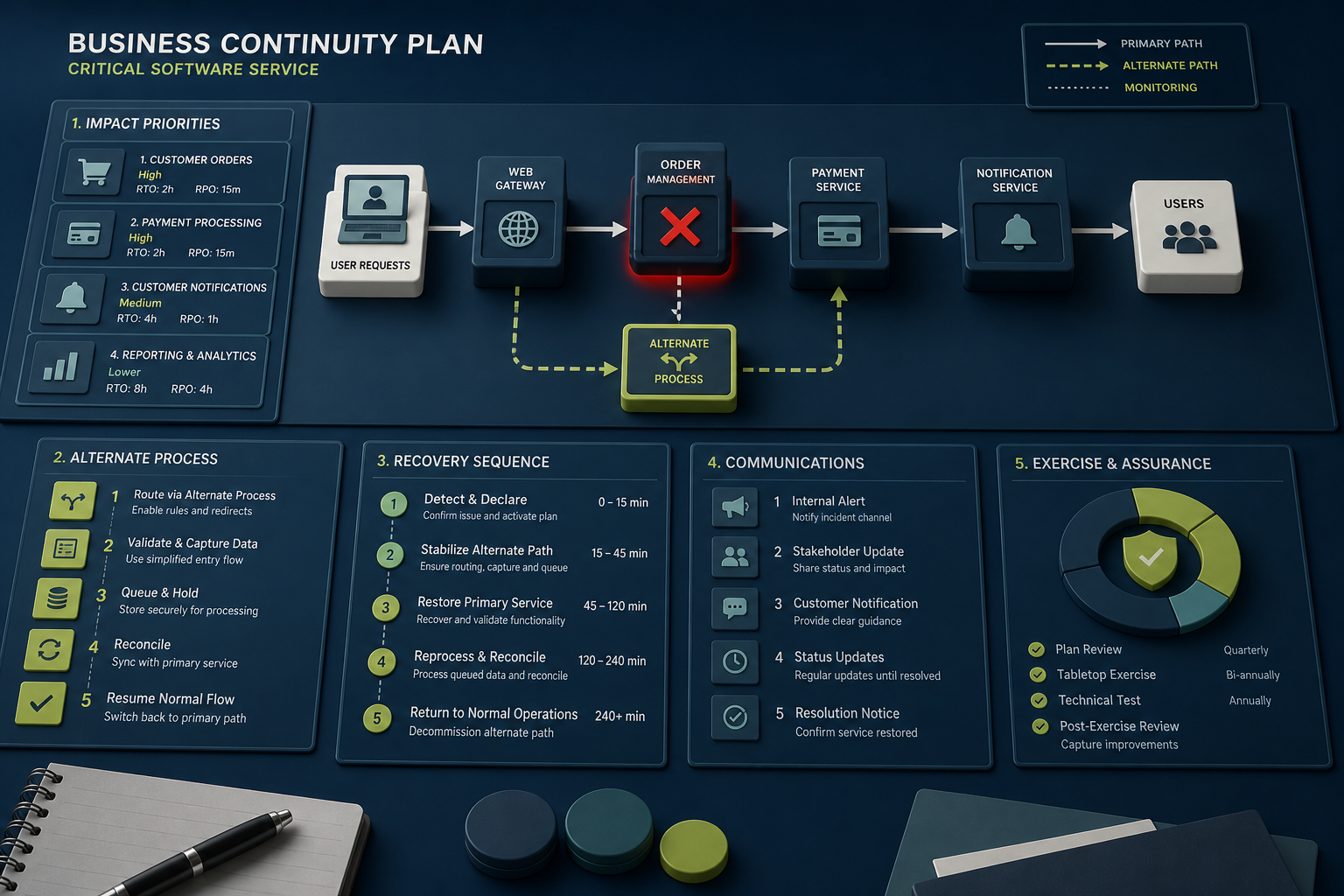
Prioritise outcomes rather than systems in isolation. Determine which transaction, record or decision must return first and which alternate process is safe for a bounded period. Manual workarounds need capacity, access, control and later reconciliation.
Use the NIST incident response recommendations in SP 800-61 Revision 3 as a current framework for integrating incident response with cybersecurity risk management. It is US federal guidance, so adapt its recommendations to the organisation and applicable obligations.
Define recovery validation: security state, data integrity, backlog, integrations, permissions, monitoring and representative user journeys. Restoring login does not prove that records are complete or queued actions have not duplicated.
Turn observations into owned improvements
Run a short debrief immediately and a deeper review after participants can verify evidence. Reconstruct the decision timeline, assumptions, delays, successful controls and workarounds. Distinguish a missing document from a design problem or training need.
Assign actions with owner, due date, evidence of completion and priority based on consequence. Retest material changes. Closing an action because a policy was updated is insufficient when the exercise exposed missing access, supplier information or technical recovery capability.
Feed recurring support and integration lessons into the service desk pathway and run a focused API dependency review where external interfaces shaped the event.
Build a proportionate exercise cadence
Exercise high-impact or fast-changing services more often and after material architecture, supplier or operating changes. Vary scenarios across confidentiality, integrity and availability. Include business owners and alternates rather than allowing security teams to rehearse alone.
Progress from discussion to technical validation. A tabletop can expose authority and information gaps; a controlled test can verify export, credential rotation, recovery or alternate processing. Use production only with explicit safeguards and approval.
A successful tabletop does not mean participants solved the fictional crisis elegantly. It means the organisation found weaknesses while change was safe, preserved the evidence and improved its ability to make responsible decisions during a real event.
Add supplier and continuity evidence to the exercise pack
Use NIST SP 800-34 Revision 1 on contingency planning to challenge the link between incident decisions and continuity. Its federal guidance covers business impact, recovery strategies, exercises and maintenance. Adapt the concepts to the service rather than claiming formal alignment.
Include the current supplier support plan, status source, contract owner, data-flow map, critical contacts and alternate-process instructions. Mark documents that participants could not reach with ordinary incident access. Availability of evidence is part of the exercise result.
Finish by deciding which finding needs a document change, technical test, supplier discussion or authority decision. Assigning every gap to “update the plan” hides the different causes and creates a longer document without stronger response capability.