Continuity begins with the business outcome at risk
A software business continuity plan should explain how priority work continues or recovers when a service, supplier, integration, location or team is unavailable. A backup procedure is only one technical control. It does not decide which journey returns first, how users work meanwhile or how delayed records are reconciled.
Choose a bounded service and map its outcomes, users, peak periods, information, applications, suppliers, identities, interfaces and manual capacity. Then identify the disruption the organisation can tolerate before safety, customers, finance, compliance or operations suffer material harm.
Record assumptions separately from tested capability. A vendor commitment, cloud architecture statement and unexercised runbook may support planning, but they do not prove recovery in the configured environment. Evidence should improve through exercises and controlled technical tests.
| Decision | Question | Evidence |
|---|---|---|
| Priority | Which outcome returns first? | Business impact analysis |
| Alternate path | How does work continue safely? | Capacity and control test |
| Recovery | What must be restored and reconciled? | Runbook and exercise |
| Communication | Who needs what update? | Contacts and templates |
| Assurance | Which assumptions remain unproven? | Action and retest record |
Run a business impact analysis by journey
Identify the transaction, decision or service result rather than rating the application alone. An ERP may support payroll, purchasing, reporting and inventory with different tolerances and calendar peaks. Record impact over time and the minimum information or function needed at each stage.
Estimate work backlog, manual capacity, customer effect, financial exposure, legal or contractual consequences and dependencies. Use ranges and evidence. Do not invent a precise loss figure merely to make the priority look objective.
Set recovery time and recovery point objectives as planning targets, then confirm that architecture, supplier commitments, people and tests can support them. A target without a funded recovery method is a requirement gap, not assurance.
Map dependencies and single points of failure
Trace identity, network, devices, data stores, integrations, queues, administrators, suppliers and key records behind each priority journey. Include the communication and decision channels used during disruption. A recovery portal is unhelpful if it depends on the same unavailable identity provider.
Use the enterprise integration inventory to connect interface failure with business impact. Identify where queued, duplicated, lost or out-of-order events could complicate return to service.
Review concentration across services. Several applications may use one integration platform, managed provider, DNS service or specialist administrator. Service-by-service plans can miss the common dependency that creates simultaneous failure.
Design alternate processing with real limits
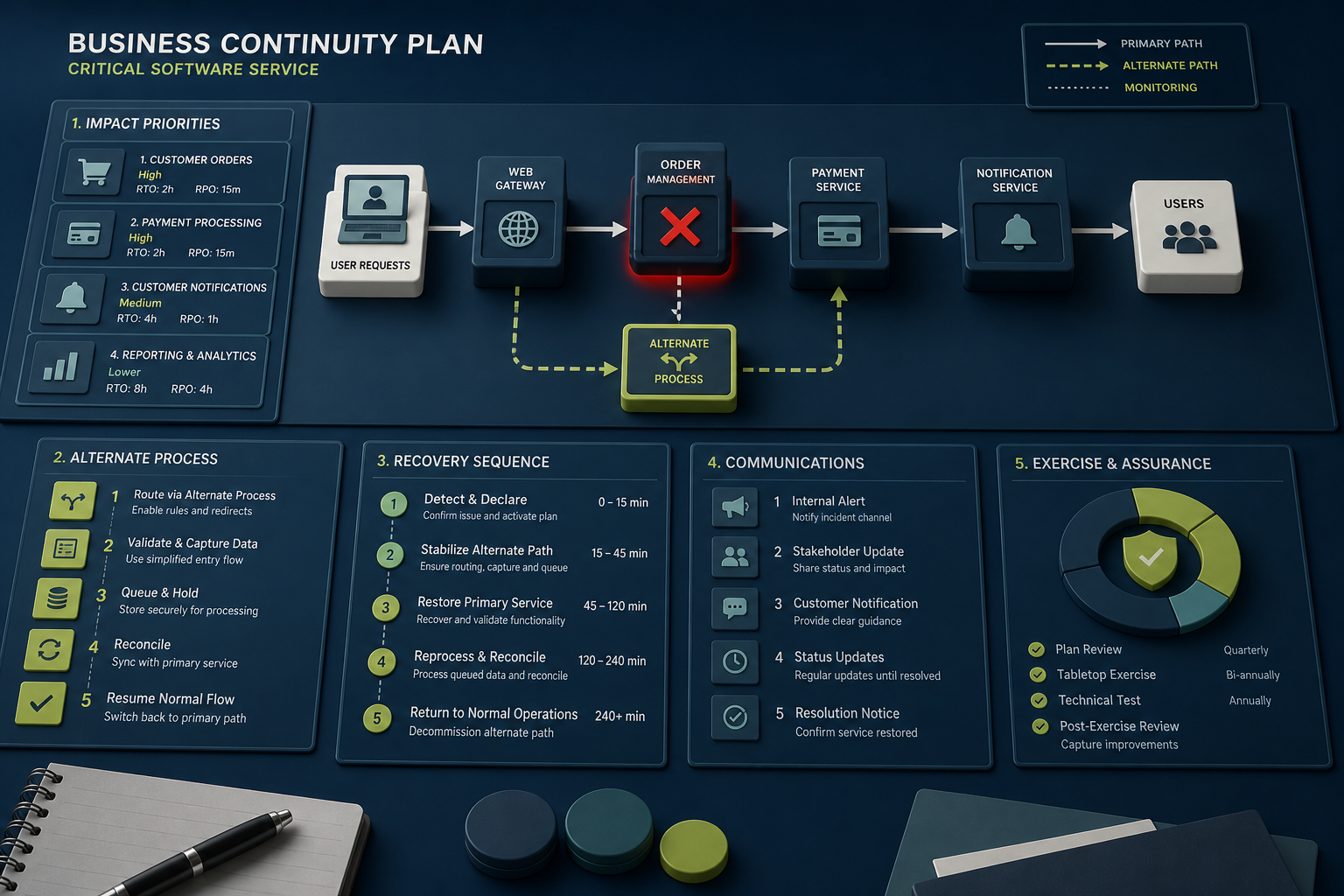
Define a safe temporary process for the highest-priority outcome: manual capture, offline form, alternate supplier, read-only data, delayed processing or reduced service. State who activates it, which cases qualify, what information is recorded and which controls remain.
Calculate capacity and duration. A manual process that handles one percent of normal volume cannot be described as continuity for the full service. Prioritise cases, set queues and communicate limits so staff do not invent incompatible workarounds.
Protect information during the workaround. Spreadsheets, email and local files may bypass access, validation and retention controls. Use approved locations, minimum data, named owners and a planned reconciliation and deletion step.
Write recovery as a sequence of verified states
A runbook should name trigger, authority, prerequisites, access, steps, expected evidence, decision points, fallback and contacts. Keep sensitive credentials in the approved secure system rather than inside the document. Test that responders can reach both.
The NIST Contingency Planning Guide in SP 800-34 Revision 1 covers business impact analysis, preventive controls, recovery strategies, plans, testing, training and maintenance. It is federal guidance, so scale and adapt it to the organisation.
Restore in dependency order and validate after each stage. Infrastructure availability, application start, identity, data integrity, interfaces, backlog and user journeys are separate states. Define who can approve progression and when a rollback or alternate path remains safer.
Plan reconciliation before disruption
Decide how work captured during outage is identified, validated, sequenced and entered after recovery. Preserve original times, approvals and evidence. Avoid bulk entry that makes duplicate detection or accountability impossible.
Identify automated events that may replay when connections return. Use unique identifiers, idempotent processing and control totals where appropriate. Sample the complete journey, including downstream reports and notifications, before declaring normal operation.
Assign ownership for exceptions and define closure evidence. Recovery is incomplete while material records remain in an unexplained queue, even if the primary interface is available. Keep stakeholders informed about the difference.
Coordinate suppliers and internal authority
Record supplier support entitlement, customer identifiers, escalation, status sources, incident communications and contractual recovery evidence. Test access and alternates. A project contact who left months ago is not a continuity control.
Clarify what the supplier restores and what the customer must restore, validate or reconfigure. Shared responsibility often covers identity, integrations, data quality, endpoint access and local communication. Put these boundaries into the plan and exercise.
Use the SaaS exit plan when disruption could become long-term supplier unavailability. Continuity and exit overlap but do not share every objective: one restores the current service, while the other enables a controlled change of destination.
Communicate decisions, impact and safe action
Prepare audience, owner, channel and cadence for staff, customers, partners and leadership. State what is known, the current impact, safe workaround, prohibited action and next update. Avoid promising restoration times before evidence supports them.
Coordinate service desk, incident team and business owners. User reports can reveal affected cohorts and recovery, while inconsistent advice can create duplicate work or unsafe data handling. Use one approved source with clear escalation.
Plan accessibility and channel failure. A status page, email or collaboration tool may be unavailable or unusable to some people. Keep proportionate alternatives and ensure messages remain understandable under pressure.
Exercise, measure and maintain the plan
Run tabletop exercises for authority, supplier and communication decisions, then technical tests for backup, restore, alternate processing and reconciliation. Select scope and safeguards explicitly. Not every production service can tolerate an unannounced failover test.
Measure activation, decision, recovery, backlog clearance, data loss, manual capacity and evidence gaps. Compare with objectives and explain variation. A passed exercise should still record limitations and untested dependencies.
Update after incidents, exercises, supplier changes, releases, reorganisations and new integrations. The plan succeeds when responsible people can continue the priority outcome within known limits and prove a coherent return to normal service.
Connect continuity, incident response and routine service ownership
Use NIST SP 800-61 Revision 3 incident response recommendations to test how detection, response and recovery fit the wider risk programme. Its federal setting requires adaptation, but it helps prevent continuity plans from starting only after the incident team has completed its work.
Review routine service ownership against the continuity plan. Monitoring, support, change and supplier management should maintain the contacts, dependencies and recovery evidence used during disruption. A separate continuity folder cannot compensate for weak daily operation.
Track the age of each critical assumption and the last exercise that challenged it. Prioritise a technical or business test when new integrations, volumes, suppliers or roles make old evidence unreliable. Maintenance should follow service change, not only an annual calendar.
Record the decision from every exercise, including accepted gaps, named owners and review dates. This turns lessons into governed work and gives the next exercise a concrete baseline instead of relying on participants to remember what changed.